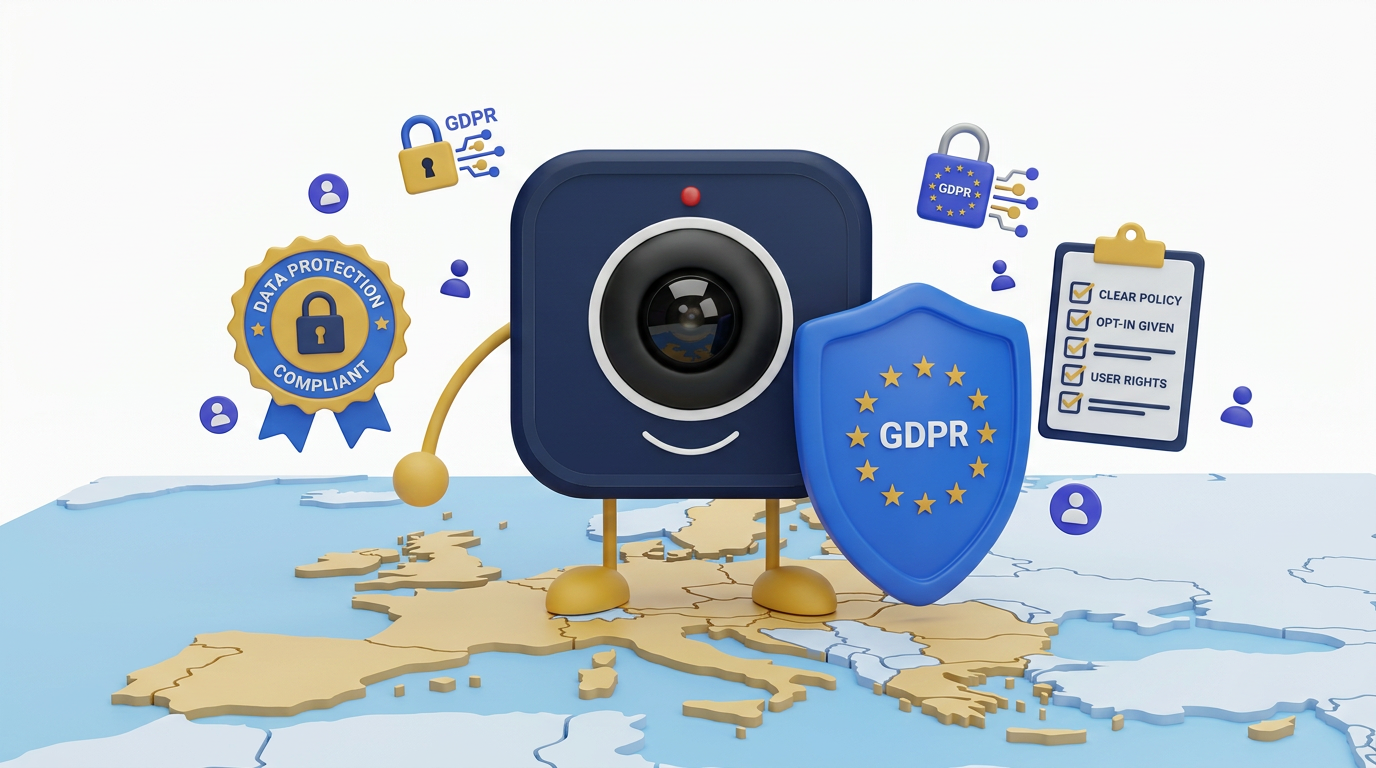
A Complete Guide to GDPR Compliance for Video Conferencing
The General Data Protection Regulation (GDPR) applies to video conferencing whenever you process personal data of individuals located in the European Economic Area. This comprehensive guide covers the legal framework, data processing agreements, lawful bases for processing, data subject rights, cross-border transfer mechanisms, and a practical compliance checklist for organizations using video platforms like DigitalMeet.
When GDPR Applies to Video Conferencing
Territorial Scope
GDPR (Regulation (EU) 2016/679) applies when you process personal data of individuals in the EEA, regardless of where your organization is located (Article 3). In a video conferencing context, personal data includes:
- Participant names, email addresses, and IP addresses
- Audio and video recordings containing identifiable individuals
- Chat messages and shared files
- Meeting metadata (join/leave times, duration, device information)
- AI-generated transcripts and summaries containing identifiable speech
GDPR Article 4(1): “‘Personal data’ means any information relating to an identified or identifiable natural person.” Video recordings, voice recordings, and behavioral metadata all qualify when they relate to an identifiable person.
Key GDPR Articles for Video Conferencing
| Article | Topic | Relevance to Video Conferencing |
|---|---|---|
| Article 5 | Principles of processing | Lawfulness, fairness, transparency, purpose limitation, data minimization, accuracy, storage limitation, integrity and confidentiality, accountability |
| Article 6 | Lawful basis for processing | You must identify a lawful basis (consent, contract, legitimate interest, etc.) for each processing activity |
| Article 9 | Special categories of data | Health data in telehealth video requires explicit consent or another Article 9 exception |
| Article 13/14 | Information to data subjects | Provide clear privacy notices before or at the time of data collection (meeting join) |
| Article 15–22 | Data subject rights | Access, rectification, erasure, restriction, portability, objection, automated decision-making |
| Article 25 | Data protection by design and default | Platform must implement privacy-protective defaults (e.g., recording off by default, minimal data collection) |
| Article 28 | Processor obligations | Your video vendor (processor) must have a Data Processing Agreement specifying processing instructions, security measures, sub-processors, and audit rights |
| Article 32 | Security of processing | Encryption, access controls, resilience, and regular testing appropriate to the risk |
| Article 33/34 | Breach notification | Notify supervisory authority within 72 hours; notify data subjects if high risk |
| Articles 44–49 | International transfers | Transfers outside the EEA require adequate safeguards (SCCs, adequacy decisions, BCRs) |
Data Processing Agreements
Article 28 Requirements
When you use a video conferencing platform, the provider acts as a data processor under GDPR. Article 28 requires a written contract (DPA) that specifies:
- Subject matter and duration of processing
- Nature and purpose of processing
- Type of personal data and categories of data subjects
- Obligations and rights of the controller
- Security measures the processor must implement (Article 32)
- Sub-processor engagement terms and notification
- Assistance with data subject rights and breach notification
- Audit rights for the controller
- Data return or deletion upon contract termination
DigitalMeet offers GDPR-aligned DPAs that cover video, recording, transcription, AI processing, and storage. Our DPA includes sub-processor lists, security commitments, and audit provisions.
Lawful Basis and Consent
Every processing activity involving personal data requires a lawful basis under Article 6. For video conferencing, common bases include:
- Contract (Article 6(1)(b)) — Processing necessary for performing a contract (e.g., providing a video meeting as part of a service agreement)
- Legitimate interest (Article 6(1)(f)) — Processing necessary for a legitimate interest that is not overridden by the data subject’s rights (e.g., internal business meetings)
- Consent (Article 6(1)(a)) — Freely given, specific, informed, and unambiguous consent (often required for recording and AI processing)
For recording and transcription, consent is the most common basis because these activities go beyond what is strictly necessary for the meeting itself. Consent must be obtained before recording begins, and participants must be able to withdraw consent without detriment.
Data Subject Rights
GDPR grants individuals comprehensive rights over their personal data. Your organization and your video platform must support these rights:
| Right | GDPR Article | Video Conferencing Application | Response Deadline |
|---|---|---|---|
| Right of access | Article 15 | Provide copies of recordings, transcripts, metadata involving the data subject | 1 month (extendable by 2 months) |
| Right to rectification | Article 16 | Correct inaccurate personal data in meeting records or participant profiles | 1 month |
| Right to erasure (“right to be forgotten”) | Article 17 | Delete recordings, transcripts, and metadata upon valid request | 1 month |
| Right to restriction | Article 18 | Restrict processing while accuracy or lawfulness is contested | 1 month |
| Right to data portability | Article 20 | Export meeting data in a structured, machine-readable format | 1 month |
| Right to object | Article 21 | Object to processing based on legitimate interest; must cease unless compelling grounds exist | Without undue delay |
| Rights related to automated decision-making | Article 22 | If AI features make automated decisions with legal or significant effects, provide human review option | 1 month |
DigitalMeet supports data export, deletion (including right-to-be-forgotten workflows), and audit trails that document compliance with data subject requests.
Cross-Border Data Transfers
Transfer Mechanisms Under Articles 44–49
Transferring personal data outside the EEA is restricted under GDPR Articles 44–49. Valid transfer mechanisms include:
| Transfer Mechanism | GDPR Article | Description | Considerations |
|---|---|---|---|
| Adequacy decision | Article 45 | European Commission determines the recipient country ensures adequate protection | Currently includes UK, Japan, South Korea, and others; the EU-U.S. Data Privacy Framework applies to certified U.S. organizations |
| Standard Contractual Clauses (SCCs) | Article 46(2)(c) | Pre-approved contract terms between data exporter and importer | Must conduct a Transfer Impact Assessment (TIA); supplement with technical measures if needed |
| Binding Corporate Rules (BCRs) | Article 47 | Intra-group data transfer policies approved by supervisory authorities | Complex and time-consuming to establish; suitable for large multinationals |
| Derogations (consent, contract necessity) | Article 49 | Limited exceptions for specific situations | Not suitable for systematic, large-scale transfers |
DigitalMeet’s configurable data residency allows you to keep EEA data entirely within the EEA, eliminating the need for cross-border transfer mechanisms. Where transfers are necessary, DigitalMeet supports SCCs and participates in applicable frameworks. For data residency architecture, see Data Residency and Compliance.
Checklist for Compliance Officers
- ☐ Data Processing Agreement executed with video provider (Article 28)
- ☐ Lawful basis identified and documented for each processing activity (Article 6)
- ☐ Privacy notice updated to include video conferencing data processing (Articles 13/14)
- ☐ Consent mechanism implemented for recording and transcription (Article 6(1)(a))
- ☐ Data subject rights procedures defined and tested (Articles 15–22)
- ☐ Data residency configured to keep EEA data in the EEA (Articles 44–49)
- ☐ Transfer Impact Assessment completed for any non-EEA transfers
- ☐ Security measures verified: encryption, access controls, audit logging (Article 32)
- ☐ Breach notification procedures aligned with 72-hour requirement (Articles 33/34)
- ☐ Data Protection Impact Assessment conducted if high-risk processing (Article 35)
- ☐ Sub-processor list reviewed and monitoring process established
- ☐ Retention policies configured and auto-deletion tested
Frequently Asked Questions
Does DigitalMeet comply with GDPR?
Yes. DigitalMeet offers GDPR-aligned Data Processing Agreements, supports all data subject rights, provides configurable data residency, and implements the security measures required by Article 32.
Can we store EU data exclusively in the EU?
Yes. DigitalMeet’s per-tenant data residency controls allow you to restrict all meeting data—recordings, metadata, transcripts—to EU data centers.
How do we handle deletion requests under Article 17?
DigitalMeet supports deletion workflows for recordings, transcripts, and participant data. Audit trails document the deletion for compliance verification.
What lawful basis should we use for recording meetings?
Consent (Article 6(1)(a)) is the most common basis for recording. Ensure consent is obtained before recording begins and that participants can withdraw consent.
Does DigitalMeet use sub-processors?
Yes. Our DPA includes a current sub-processor list with notification provisions for changes, as required by Article 28(2).
Do we need a Data Protection Impact Assessment (DPIA)?
If your video conferencing involves high-risk processing—such as large-scale recording, AI analysis of communications, or processing special category data—a DPIA under Article 35 is likely required.
How does DigitalMeet handle breach notification?
Our DPA commits to notifying you without undue delay upon discovering a personal data breach, enabling you to meet the 72-hour supervisory authority notification requirement under Article 33.
What about the ePrivacy Directive?
The ePrivacy Directive (2002/58/EC) applies to the confidentiality of electronic communications. Recording conversations may trigger ePrivacy obligations in addition to GDPR. Check your member state’s implementation for specific requirements. See Meeting Recording Laws by Country for jurisdiction-specific rules.