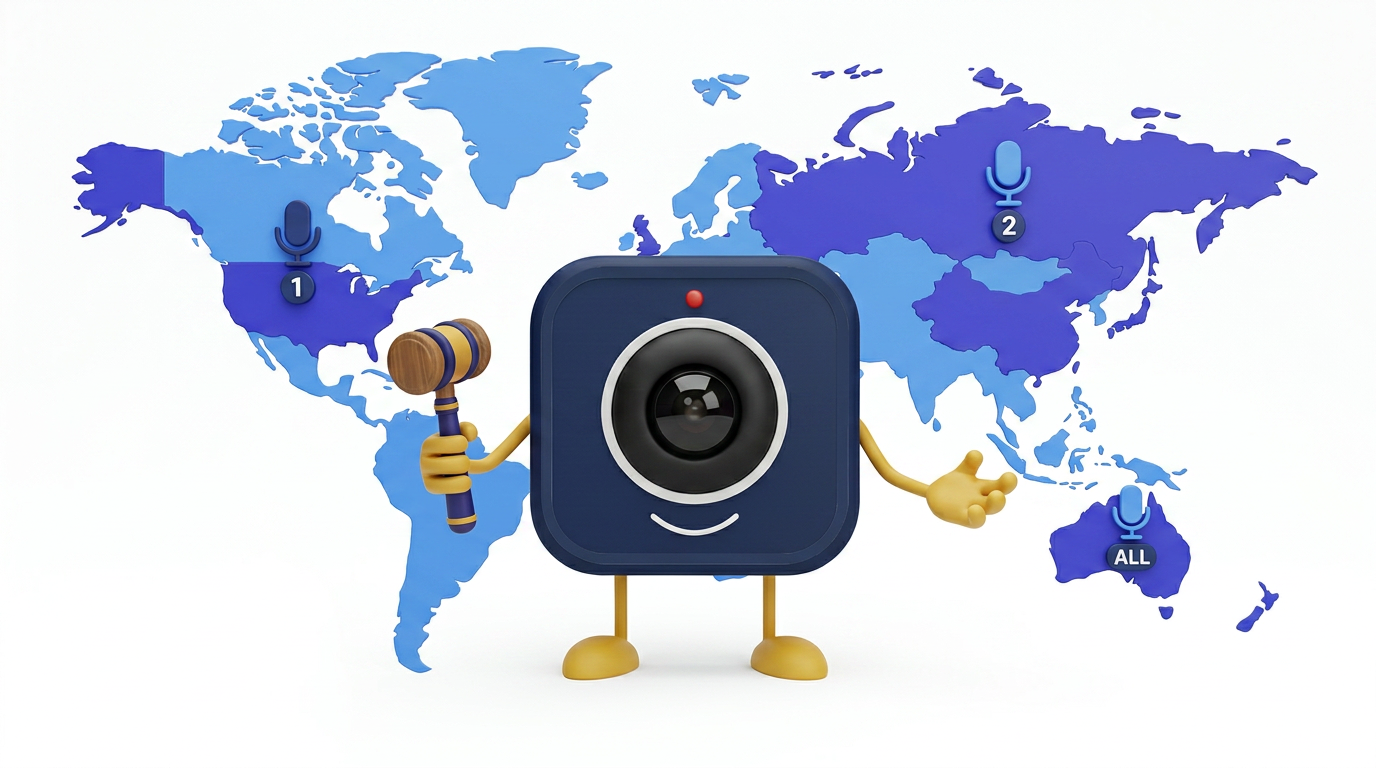
Meeting Recording Laws by Country: What You Need to Know Before You Hit Record
Recording a video meeting can create evidence, support compliance, and preserve institutional knowledge—but it can also create legal liability if done without proper consent. Laws vary dramatically by country and, in the United States, by state. This comprehensive guide summarizes the consent requirements, penalties, and best practices you need to know before you press record.
Understanding Consent Models
Recording consent laws generally follow one of two models:
- One-party consent: Only one participant in the conversation needs to consent to the recording. The person initiating the recording can be that one party.
- All-party (two-party) consent: Every participant in the conversation must consent before the recording can legally begin.
When participants are in different jurisdictions, the prevailing legal guidance is to apply the most restrictive rule among all participants’ locations.
United States: State-by-State Consent Requirements
The federal Wiretap Act (18 U.S.C. § 2511) establishes a one-party consent baseline. However, many states impose stricter all-party consent requirements. Below is a reference table for key U.S. states:
| State | Consent Type | Key Statute | Criminal Penalty | Civil Remedy |
|---|---|---|---|---|
| California | All-party | Cal. Penal Code § 632 | Fine up to $2,500; imprisonment up to 1 year | $5,000 per violation or three times damages |
| Florida | All-party | Fla. Stat. § 934.03 | Third-degree felony (up to 5 years) | Actual damages, $100/day for each day of violation, or $1,000 |
| Illinois | All-party | 720 ILCS 5/14-2 | Class 4 felony (1–3 years) | $10,000 or actual damages plus attorney fees |
| Pennsylvania | All-party | 18 Pa. C.S. § 5703 | Third-degree felony | Actual damages plus $100/day, minimum $1,000 |
| Massachusetts | All-party | Mass. Gen. Laws ch. 272, § 99 | Imprisonment up to 5 years; fine up to $10,000 | Actual damages, $100/day minimum, attorney fees |
| Maryland | All-party | Md. Code, Cts. & Jud. Proc. § 10-402 | Felony; up to 5 years imprisonment | Actual damages plus attorney fees |
| Washington | All-party | Wash. Rev. Code § 9.73.030 | Gross misdemeanor | $100/day for each day of violation, or actual damages |
| Connecticut | All-party | Conn. Gen. Stat. § 52-570d | Class D felony | Civil damages available |
| New Hampshire | All-party | N.H. Rev. Stat. Ann. § 570-A:2 | Class B felony | Actual damages, $1,000 minimum, attorney fees |
| Montana | All-party | Mont. Code Ann. § 45-8-213 | Fine up to $500; 6 months imprisonment | Civil damages available |
| New York | One-party | N.Y. Penal Law § 250.00 | Class E felony (wiretapping) | Civil damages available |
| Texas | One-party | Tex. Penal Code § 16.02 | State jail felony | $10,000 or actual damages, plus attorney fees |
| Georgia | One-party | Ga. Code Ann. § 16-11-66 | Felony; 1–5 years imprisonment | Actual damages plus attorney fees |
| Ohio | One-party | Ohio Rev. Code § 2933.52 | Fourth-degree felony | Civil damages available |
European Union and United Kingdom
In the EU, recording consent is governed by the intersection of GDPR and the ePrivacy Directive (2002/58/EC), as implemented by each member state.
GDPR Article 6(1)(a): Consent must be “freely given, specific, informed and unambiguous.” For meeting recordings, this typically means obtaining explicit opt-in consent from all participants before recording begins.
Key European Jurisdictions
| Country | Consent Type | Legal Framework | Key Requirement |
|---|---|---|---|
| Germany | All-party | StGB § 201; GDPR | Criminal penalties for unauthorized recording; strict GDPR enforcement |
| France | All-party | Code Pénal Art. 226-1; GDPR | Up to 1 year imprisonment and €45,000 fine |
| United Kingdom | One-party (with GDPR-equivalent obligations) | RIPA 2000; UK GDPR; Data Protection Act 2018 | Lawful to record own calls; GDPR obligations apply to storage and processing |
| Netherlands | One-party (with GDPR obligations) | Dutch Telecommunications Act; GDPR | One-party consent for recording; GDPR applies to processing |
| Spain | One-party (with GDPR obligations) | Spanish Constitution Art. 18; GDPR | One party may record; sharing may require additional consent |
| Italy | One-party (with GDPR obligations) | Italian Privacy Code; GDPR | Recording by a participant is generally lawful; processing requires GDPR basis |
Other Major Jurisdictions
| Country | Consent Type | Legal Framework | Key Notes |
|---|---|---|---|
| Canada | One-party (federal) | Criminal Code § 184 | Provincial privacy laws may add requirements; PIPEDA applies to commercial recordings |
| Australia | All-party (most states) | Surveillance Devices Act 2004; state equivalents | NSW and Victoria require all-party consent; penalties vary by state |
| Japan | No specific prohibition (general privacy) | Act on Protection of Personal Information | No wiretapping-specific law; privacy and purpose limitation principles apply |
| India | One-party (evolving) | Indian Telegraph Act; IT Act 2000; Digital Personal Data Protection Act 2023 | One-party consent generally accepted; new data protection law may add requirements |
| Brazil | One-party | Federal Constitution; LGPD | One party may record; LGPD applies to storage and processing of personal data |
| Singapore | One-party | PDPA; Computer Misuse Act | Lawful to record own conversations; PDPA applies to processing |
| South Korea | One-party (strict) | Protection of Communications Secrets Act | Party to the conversation may record; third-party recording requires court order |
| UAE | All-party | Federal Decree-Law No. 34/2021 (Cybercrimes) | Recording without consent is a criminal offense; penalties include imprisonment and fines |
Cross-Border Meeting Best Practices
When participants are located in different jurisdictions:
- Identify all participants’ locations before the meeting starts.
- Apply the most restrictive consent requirement among all jurisdictions.
- Disclose recording clearly at the start of the meeting—verbally and via platform notification.
- Obtain affirmative consent from all participants before recording begins.
- Document consent in your meeting records. DigitalMeet’s audit logs capture recording start events and participant lists.
- Provide opt-out options — Participants who do not consent should be able to leave or participate without being recorded.
DigitalMeet Recording Controls
DigitalMeet supports compliant recording workflows through:
- Host-controlled recording — Only designated hosts can start and stop recording.
- Visual and audio indicators — All participants see and hear when recording is active.
- Configurable recording policies — Administrators can enable, disable, or mandate recording per meeting type.
- Retention policies — Set per-meeting-type retention schedules with automatic deletion.
- Data residency — Recordings are stored in the region(s) you configure.
- Legal hold — Override auto-deletion when preservation obligations arise.
For legal-specific use cases, see Video Conferencing for Law Firms. For GDPR-specific recording guidance, see GDPR Compliance for Video Conferencing.
Frequently Asked Questions
Can I record a meeting without telling participants?
In many jurisdictions, no. All-party consent states and countries require every participant to agree before recording. Even in one-party consent jurisdictions, best practice is to disclose recording and obtain consent.
What is two-party (all-party) consent?
It means every participant in the conversation must consent before the conversation can be legally recorded. Despite the name “two-party,” it applies to all participants regardless of how many are on the call.
Which U.S. states require all-party consent?
As of this writing, all-party consent states include California, Connecticut, Florida, Illinois, Maryland, Massachusetts, Montana, New Hampshire, Pennsylvania, and Washington. Laws change; consult current statutes.
What happens if participants are in different jurisdictions?
Apply the most restrictive consent requirement among all participants’ locations. If one participant is in California (all-party) and another is in New York (one-party), all-party consent applies.
Does DigitalMeet support recording consent workflows?
DigitalMeet provides host-controlled recording with visual and audio indicators. The platform notifies all participants when recording is active. You are responsible for obtaining consent as required by applicable law.
How should we handle international video calls?
Identify where all participants are located, determine the applicable consent requirements, and apply the strictest rule. Document consent in your meeting records.
Are recordings subject to GDPR?
Yes. Video recordings containing identifiable individuals are personal data under GDPR. You need a lawful basis (typically consent) and must honor data subject rights. See GDPR Compliance for Video Conferencing.
How long should we retain recordings?
Retain recordings only as long as required by law, regulation, contract, or legitimate business purpose. Configure per-meeting-type retention policies in DigitalMeet. See Video Conferencing Data Retention for detailed guidance.