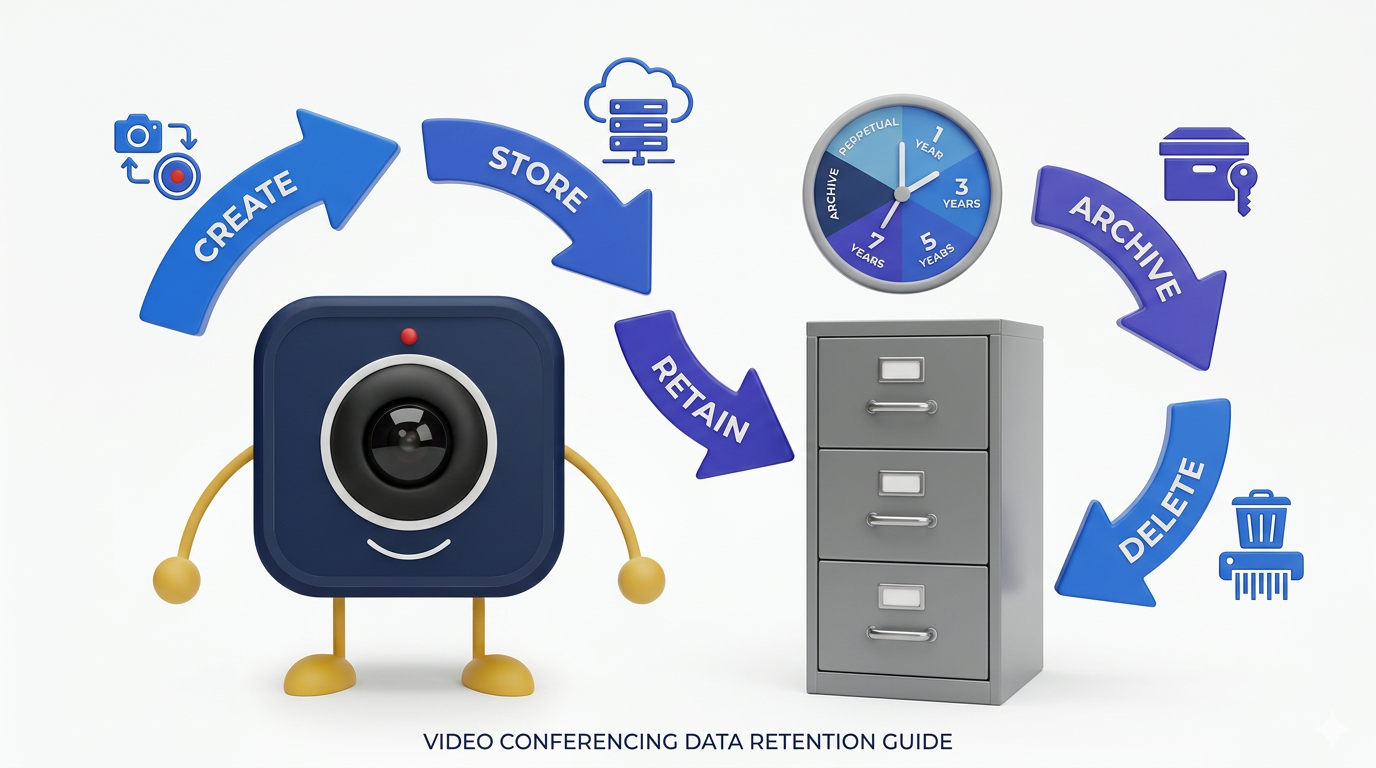
Video Conferencing Data Retention: A Guide for Legal and Compliance Teams
Video conferencing recordings, transcripts, chat logs, and metadata are simultaneously evidence, training assets, intellectual property, and personal data. Legal and compliance teams need a structured approach to how long this data is kept, who can access it, when it must be deleted, and how to handle conflicting requirements across jurisdictions and regulations. This guide provides the framework, tables, and checklists you need to build a defensible retention program.
Why Data Retention Matters for Video Conferencing
Organizations face pressure from multiple directions when it comes to meeting data:
- Regulatory mandates require retention for specified periods (SEC Rule 17a-4, MiFID II Article 16, HIPAA).
- Privacy regulations require deletion when data is no longer necessary (GDPR Article 5(1)(e) storage limitation principle).
- Litigation holds require preservation that overrides normal deletion schedules.
- Operational needs drive requests to retain data for training, quality assurance, and knowledge management.
GDPR Article 5(1)(e) — Storage Limitation: “Personal data shall be kept in a form which permits identification of data subjects for no longer than is necessary for the purposes for which the personal data are processed.” This creates a legal obligation to define and enforce retention limits.
Define What You Retain
Not all meeting data is equal. Inventory each data type and map it to applicable retention rules:
Retention Schedule Template by Data Type
| Data Type | Description | Common Regulatory Trigger | Recommended Default Retention | Notes |
|---|---|---|---|---|
| Meeting metadata | Participant list, join/leave times, duration, meeting title | GDPR, HIPAA, SOC 2 audit requirements | 1–3 years | Low storage cost; useful for compliance verification |
| Chat messages | In-meeting text chat | GDPR, SEC 17a-4, FINRA 4511 | 3–7 years (regulated) / 1 year (general) | May contain PII or business-critical information |
| Video recordings | Full audio/video capture of the meeting | SEC 17a-4, MiFID II Art. 16, HIPAA, state recording laws | 3–7 years (regulated) / 90 days (general) | Highest storage cost; greatest privacy impact |
| Audio-only recordings | Voice capture without video | Same as video recordings | 3–7 years (regulated) / 90 days (general) | Lower storage cost; same legal treatment as video |
| Transcripts | Text transcription of spoken content | GDPR (personal data), SEC/FINRA, HIPAA | Same as corresponding recording | Treated as personal data; searchable—higher discovery risk |
| AI summaries | AI-generated meeting summaries | GDPR (automated processing), HIPAA (ePHI) | Same as corresponding recording or shorter | May contain inferred information; document lawful basis |
| Shared files / screen captures | Documents shared during the meeting | GDPR, intellectual property policies | Aligned with document management policy | May duplicate documents retained elsewhere |
| Audit logs | System-generated event logs | SOC 2, ISO 27001, HIPAA, GDPR Art. 5(2) | 3–7 years | Essential for demonstrating compliance; low PII content |
Sector-Specific Retention Requirements
| Sector | Primary Regulation | Minimum Retention Period | Key Requirement |
|---|---|---|---|
| Financial services (U.S.) | SEC Rule 17a-4; FINRA Rule 4511 | 3–6 years | Business communications must be preserved in non-rewritable, non-erasable format for the first 2 years |
| Financial services (EU) | MiFID II Article 16(7) | 5–7 years | Order-related communications must be recorded and retained; provided to regulators on demand |
| Financial services (UK) | FCA COBS 11.8 | 5 years | Communications related to client orders must be retained and retrievable |
| Healthcare (U.S.) | HIPAA (45 CFR § 164.530(j)) | 6 years | Policies and documentation related to HIPAA compliance must be retained for 6 years; state medical record laws may impose longer periods |
| Healthcare (EU) | GDPR + national health laws | Varies by member state | Storage limitation principle applies; national laws may specify medical record retention periods |
| Legal | Bar association rules; litigation hold obligations | Duration of matter + post-closure period | Privileged materials must be protected; litigation holds override deletion schedules |
| Government (U.S.) | Federal Records Act; NARA schedules | Varies by record type | Federal agencies must follow NARA-approved retention schedules |
| Education (U.S.) | FERPA (20 U.S.C. § 1232g) | As long as records are maintained | Student education records require protection; retention aligned with institutional policy |
| General commercial (EU) | GDPR Article 5(1)(e) | No longer than necessary | Must justify retention period; delete when purpose is fulfilled |
Building a Retention Policy
Step 1: Inventory Data Types
Catalog every type of data your video platform generates or stores. Include metadata, chat, recordings (video and audio), transcripts, AI outputs, shared files, and system logs.
Step 2: Map to Regulations and Obligations
For each data type, identify all applicable regulations, contractual obligations, and litigation hold requirements. When multiple regulations apply, use the longest required retention period as your minimum and ensure the retention does not conflict with privacy law maximums.
Step 3: Define Retention Tiers
Create retention tiers aligned with your meeting types. DigitalMeet supports per-meeting-type retention policies, allowing you to apply different schedules to client calls (long retention), internal huddles (short retention), and recorded training sessions (medium retention).
Step 4: Implement Legal Hold Procedures
Legal hold must override automatic deletion when litigation, regulatory investigation, or audit is anticipated or active. Define who can initiate and release holds, how holds are communicated, and how they interact with automated retention. DigitalMeet’s legal hold feature prevents auto-deletion of specified meetings and their associated data.
Step 5: Automate and Test
Manual deletion at scale is error-prone. Configure automated retention policies in your video platform and test them in a staging environment. Verify that:
- Data is deleted on schedule when no hold is active
- Legal holds prevent deletion as expected
- Audit logs capture all deletion and export events
- Data subject deletion requests are processed within required timeframes
Deletion and Data Subject Requests
Under GDPR and similar privacy laws, data subjects have the right to request deletion of their personal data (Article 17). Your retention policy must accommodate:
- Automated deletion when retention periods expire, unless a legal hold or regulatory requirement overrides
- Individual deletion requests processed within the regulatory timeframe (1 month under GDPR)
- Partial deletion where technically feasible—for example, redacting a participant from a recording while preserving the rest
- Audit documentation of all deletion actions for compliance verification
DigitalMeet supports export and deletion workflows with full audit trails. For cross-border considerations, apply the strictest applicable rule. For GDPR-specific guidance, see GDPR Compliance for Video Conferencing.
Operational Checklist
- ☐ Written retention schedule tied to meeting categories and data types
- ☐ Retention periods mapped to all applicable regulations and contracts
- ☐ Legal hold procedures documented with clear escalation paths
- ☐ Automated retention policies configured and tested in staging
- ☐ Data subject request procedures defined with SLA targets
- ☐ Owner designated for policy updates and annual review
- ☐ Staff training on recording consent, retention indicators, and hold procedures
- ☐ Audit log review process established for deletion and export events
- ☐ Cross-border retention conflicts documented with resolution approach
- ☐ Annual retention policy review scheduled with legal, compliance, and IT stakeholders
Frequently Asked Questions
How long should we keep meeting recordings?
There is no universal answer. Your retention period should be determined by the longest applicable regulatory requirement, contractual obligation, or litigation hold—balanced against the GDPR storage limitation principle. Use the sector-specific table above as a starting point.
Are transcripts treated the same as recordings for retention purposes?
Generally yes. Transcripts contain personal data and are often subject to the same regulations as the recordings they derive from. They also carry higher discovery risk because they are text-searchable.
Can DigitalMeet enforce retention automatically?
Yes. Configure per-meeting-type retention policies in the admin console. Automated deletion occurs on schedule unless overridden by a legal hold. Test policies in staging before production deployment.
How do we handle conflicting retention requirements?
When a regulatory mandate requires retention (e.g., SEC 17a-4, 6 years) and a privacy law requires deletion (e.g., GDPR storage limitation), the regulatory mandate typically takes precedence for the mandated retention period. Document the conflict and your resolution in your data protection records. For detailed guidance, see Secure Video Meetings for Financial Services.
What is a legal hold and when do we use it?
A legal hold (also called litigation hold) is a directive to preserve relevant data when litigation, regulatory investigation, or audit is reasonably anticipated. It overrides normal retention and deletion schedules. Failure to implement a hold can result in sanctions for spoliation of evidence.
How do we handle data subject deletion requests during a legal hold?
Legal holds generally take precedence over deletion requests for the duration of the hold. Document the conflict, inform the data subject that their request is temporarily suspended due to a legal obligation, and process the deletion when the hold is released.
Does DigitalMeet support different retention policies for different meeting types?
Yes. Per-meeting-type retention is a core feature. Configure different retention schedules for client calls, internal meetings, training sessions, and other meeting categories.
How should we handle AI-generated summaries in our retention policy?
AI summaries are derived from recordings and may contain personal data or inferred information. Apply the same or shorter retention period as the source recording. Document the lawful basis for the AI processing activity. See HIPAA-Compliant Video Conferencing for healthcare-specific AI considerations.