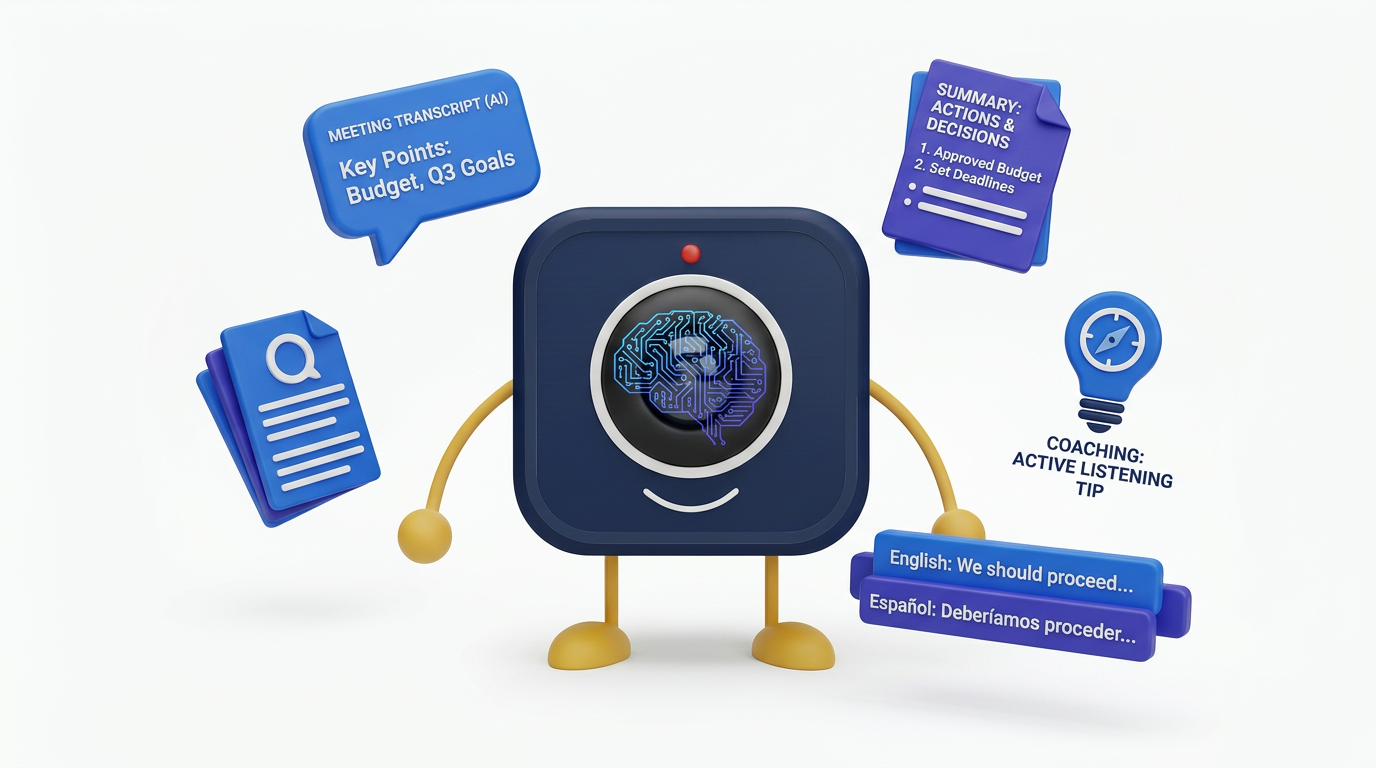
The Future of AI in Meetings: From Transcription to Real-Time Coaching
Artificial intelligence in meetings has evolved from basic transcription to real-time coaching, sentiment analysis, and predictive meeting optimization. This article maps the trajectory of AI-powered meeting intelligence—where we've been, where we are, and where the technology is heading—with a clear-eyed view of what's real, what's emerging, and what DigitalMeet is building.
The Evolution of AI in Meetings
Meeting AI has progressed through distinct phases, each unlocking new value. What began as simple speech-to-text has matured into a sophisticated ecosystem of real-time intelligence. Gartner predicts that by 2027, 75% of enterprise meetings will be automatically transcribed and summarized by AI, up from roughly 20% in 2023.
Market context: According to Forrester's 2025 AI in Collaboration report, enterprise spending on AI-powered meeting tools grew 340% between 2022 and 2025, with the fastest growth in real-time analytics and post-meeting intelligence categories.
AI Capability Evolution Timeline
| Year | Capability | Technology | Business Impact | Maturity Level |
|---|---|---|---|---|
| 2020 | Basic transcription | ASR (automatic speech recognition) | Searchable meeting records | Mature |
| 2021 | Speaker identification | Speaker diarization models | Attributed transcripts, participation tracking | Mature |
| 2022 | Post-meeting summaries | Large language models (GPT-3 era) | Reduced note-taking burden, shareable recaps | Mature |
| 2023 | Action item extraction | LLMs with structured output | Automated task creation, follow-up tracking | Production-ready |
| 2024 | Sentiment and engagement analysis | Multimodal models (text + audio cues) | Meeting health scoring, facilitator feedback | Production-ready |
| 2025 | Real-time coaching nudges | Streaming LLMs, edge inference | Live facilitation support, balanced participation | Early production |
| 2026–2027 | Predictive meeting optimization | Organizational graph + meeting data ML | Smart scheduling, meeting necessity scoring | Emerging |
| 2027–2028 | Autonomous meeting agents | Agentic AI, tool-use models | AI attends on your behalf, provides summaries | Experimental |
Current vs. Future AI Features
Understanding where AI capabilities stand today versus where they're heading helps organizations make informed adoption decisions.
AI Feature Maturity Comparison
| Feature Category | Current State (2025–2026) | Future State (2027–2028) | DigitalMeet Status |
|---|---|---|---|
| Transcription | Real-time, multi-language, 95%+ accuracy | Context-aware with jargon learning per org | Available — real-time and post-session |
| Summarization | Post-meeting summaries with key points | Real-time rolling summaries, cross-meeting synthesis | Available — post-meeting summaries |
| Action items | Extracted from transcript, assigned to speakers | Auto-created in project tools, tracked to completion | Available — extraction and export |
| Sentiment analysis | Post-meeting aggregate mood scoring | Real-time emotional intelligence, tone coaching | Analytics foundation in place |
| Participation balance | Speaking time tracking per participant | Live nudges to facilitator, inclusion scoring | Available — participation analytics |
| Meeting necessity scoring | Manual audit based on analytics | AI-driven recommendations to cancel or shorten | Analytics data supports manual scoring |
| Smart scheduling | Calendar integration, conflict detection | AI-optimized scheduling based on energy and focus | Calendar integration available |
| Meeting coaching | Post-meeting feedback reports | Real-time whisper coaching during meetings | Roadmap — building on analytics foundation |
From Transcription to Real-Time Understanding
The most significant shift in meeting AI is the move from passive recording to active understanding. Early tools simply converted speech to text. Today's systems understand context: who said what, what decisions were made, what tasks were assigned, and how participants felt about the discussion.
McKinsey's 2025 report on AI in the workplace estimates that AI-powered meeting intelligence can save knowledge workers 4–5 hours per week by automating note-taking, follow-up drafting, and meeting preparation. That's not a future projection—it's happening now at organizations that have adopted these tools.
Real-Time AI: The Next Frontier
Real-time AI moves intelligence from after the meeting to during it. Imagine a facilitator receiving a gentle nudge that one participant hasn't spoken in 10 minutes, or a real-time summary appearing in the sidebar so latecomers can catch up instantly. These capabilities are emerging now and will be standard within two years.
Expert perspective: "The real value of meeting AI isn't replacing humans—it's augmenting facilitators with information they can't process in real time. A human can't track speaking time, sentiment, and action items simultaneously while also leading the discussion." — Harvard Business Review, "The AI-Augmented Meeting" (2025)
Privacy, Control, and Trust
AI that processes meeting content must respect privacy and compliance requirements. This is non-negotiable for enterprise adoption. DigitalMeet is built with data residency, access controls, and auditability so organizations can adopt AI features without compromising compliance. Meeting data is never used to train public AI models.
Key principles for responsible meeting AI include: transparent disclosure when AI is active, participant consent for recording and analysis, data residency controls, and the ability to opt out. For DigitalMeet's approach to privacy, see Security and Privacy and GDPR Compliance for Video Conferencing.
What DigitalMeet Is Building
DigitalMeet's analytics already provide the foundation—participation tracking, engagement metrics, and trend analysis—that future AI features build upon. Our roadmap includes enhanced real-time summarization, meeting coaching insights, and deeper integration between analytics and AI-powered recommendations. For our current analytics capabilities, see Analytics and Efficiency. For the broader future of communication, see The Future of Digital Communication.
Frequently Asked Questions
Does DigitalMeet currently use AI in meetings? Yes. DigitalMeet uses AI for transcription, summarization, and analytics. Our roadmap includes expanded real-time intelligence features building on this foundation.
Is meeting data used to train AI models? No. DigitalMeet does not use your meeting content to train public AI models. Your data remains yours, governed by your privacy and data residency settings.
How does meeting analytics support future AI? Rich, structured meeting data—who spoke, when, engagement levels, participation patterns—is the essential input for AI coaching, predictive optimization, and meeting health scoring. Organizations using analytics now are building the data foundation for more advanced AI capabilities.
Will AI replace human meeting facilitators? No. AI augments facilitators by providing real-time data and nudges they can't track manually. The human facilitator remains essential for judgment, empathy, and relationship management.
What about AI bias in meeting analysis? Responsible meeting AI must be tested for bias in speaker identification, sentiment analysis, and language understanding. DigitalMeet is committed to fairness testing and transparent methodology in our AI features.
When will real-time meeting coaching be available? Real-time coaching features are in active development across the industry. DigitalMeet's analytics foundation supports our roadmap toward these capabilities. Check our product updates for the latest timeline.
How should organizations prepare for AI-powered meetings? Start by adopting meeting analytics to establish baseline data. Build comfort with AI-assisted transcription and summarization. Develop internal policies for AI use in meetings. Organizations that invest in analytics now will be best positioned to adopt advanced AI features as they mature.
Can AI help reduce the number of unnecessary meetings? Yes. AI-powered meeting necessity scoring—based on historical analytics data—can recommend which recurring meetings to cancel, shorten, or convert to async formats. This is one of the highest-ROI applications of meeting AI.